Black Tourmaline, known mineralogically as Schorl, is one of the most widely collected natural stones and a popular choice in crystal jewellery. It is notable for its deep black colour, high hardness and the distinctive striated (ridged) texture visible on raw specimens. This guide covers its physical properties, how it forms, the range of Tourmaline varieties, and how it is used in jewellery.
What is Black Tourmaline?
Black Tourmaline (Schorl) is a boron silicate mineral belonging to the Tourmaline group. It forms in igneous and metamorphic rocks and is the most common variety of the Tourmaline family by volume. Its colour ranges from very dark brown to pure jet black, and it typically forms as elongated, striated prismatic crystals. It has a vitreous (glassy) to slightly resinous lustre when cut and polished.
Physical properties at a glance
- Mineral family: Tourmaline group (boron silicate)
- Variety name: Schorl
- Colour: Deep black to very dark brown
- Mohs hardness: 7 to 7.5: highly scratch-resistant, suitable for everyday jewellery
- Lustre: Vitreous (glassy) when polished; sub-metallic on natural crystal faces
- Transparency: Opaque
- Crystal system: Trigonal
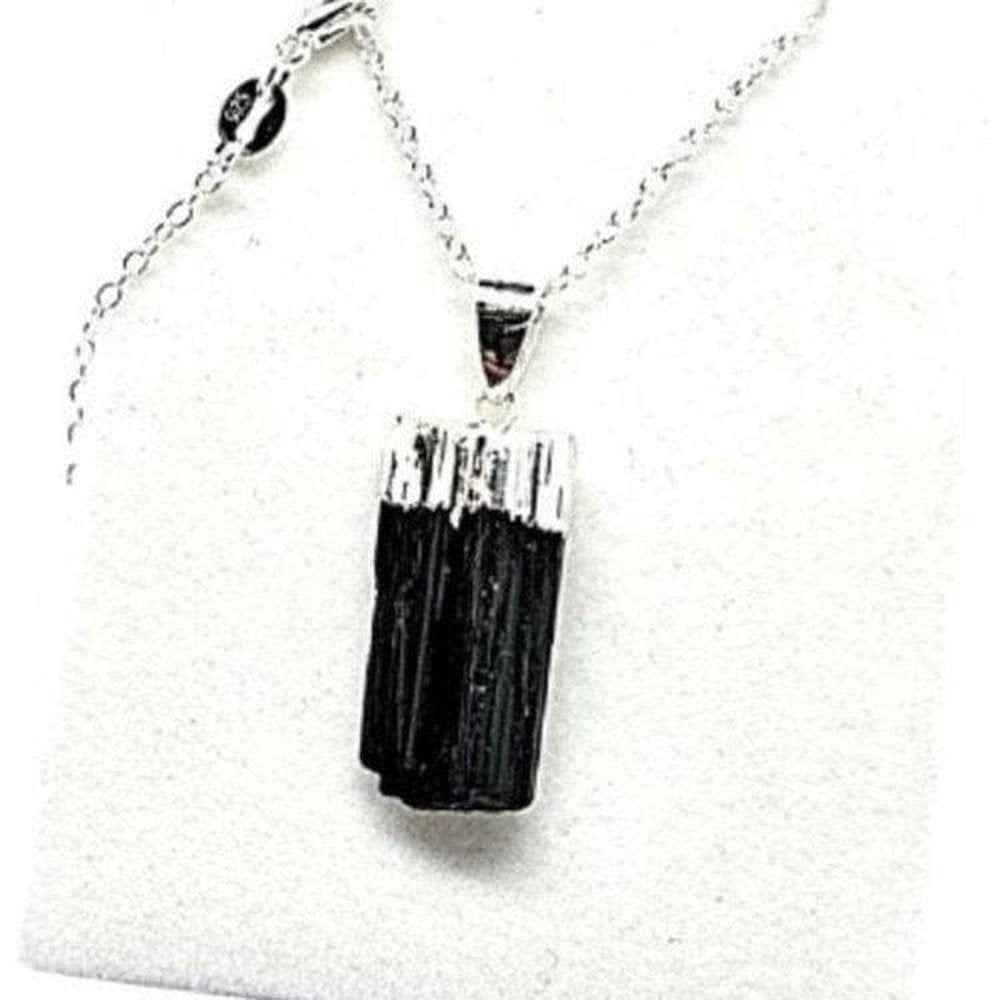
- Characteristic texture: Vertical striations (parallel ridges) along the crystal length in raw form
- Specific gravity: 3.0 to 3.2
Mohs hardness: where black tourmaline sits
- Fingernail: 2.5
- Glass or knife: 5 to 5.5
- Steel file: 6.5
- Black tourmaline: 7 to 7.5
- Diamond: 10
At 7 to 7.5, black tourmaline resists everyday scratching in jewellery, and will scratch glass, steel and most stones below 7.
How does Black Tourmaline form?
Schorl forms primarily in granitic pegmatites: coarse-grained igneous rock formations that develop slowly from magma and allow large crystals to grow. It also occurs in metamorphic schists and in alluvial deposits carried by water from the original source rock. Major commercial sources include Brazil (especially Minas Gerais), Sri Lanka, Nigeria, Namibia and Pakistan.
Tourmaline varieties: the full colour range
The Tourmaline group includes a wide range of colour varieties, each reflecting a different mineral composition. Black Tourmaline (Schorl) is by far the most abundant, but several other varieties are significant in jewellery and collecting:
- Schorl: black; the most common variety; iron-rich
- Rubellite: deep pink to red; manganese-rich; used in fine jewellery
- Indicolite: blue to blue-green; less common; iron-rich with different atomic coordination
- Verdelite: green; chromium and vanadium present; used in jewellery
- Watermelon Tourmaline: pink core with green outer zone in the same crystal; sought after as a specimen and in slices
- Paraiba Tourmaline: neon blue-green; copper-bearing; extremely rare and among the most valuable gemstones by weight
Shop Black Tourmaline at Crystals Healing UK
Black Tourmaline bracelets, necklaces and tumbled stones, hand-selected and packaged in the UK with free delivery on orders over £30.
View Tourmaline collection Black Tourmaline braceletBlack Tourmaline in jewellery
Why is Black Tourmaline used in jewellery?
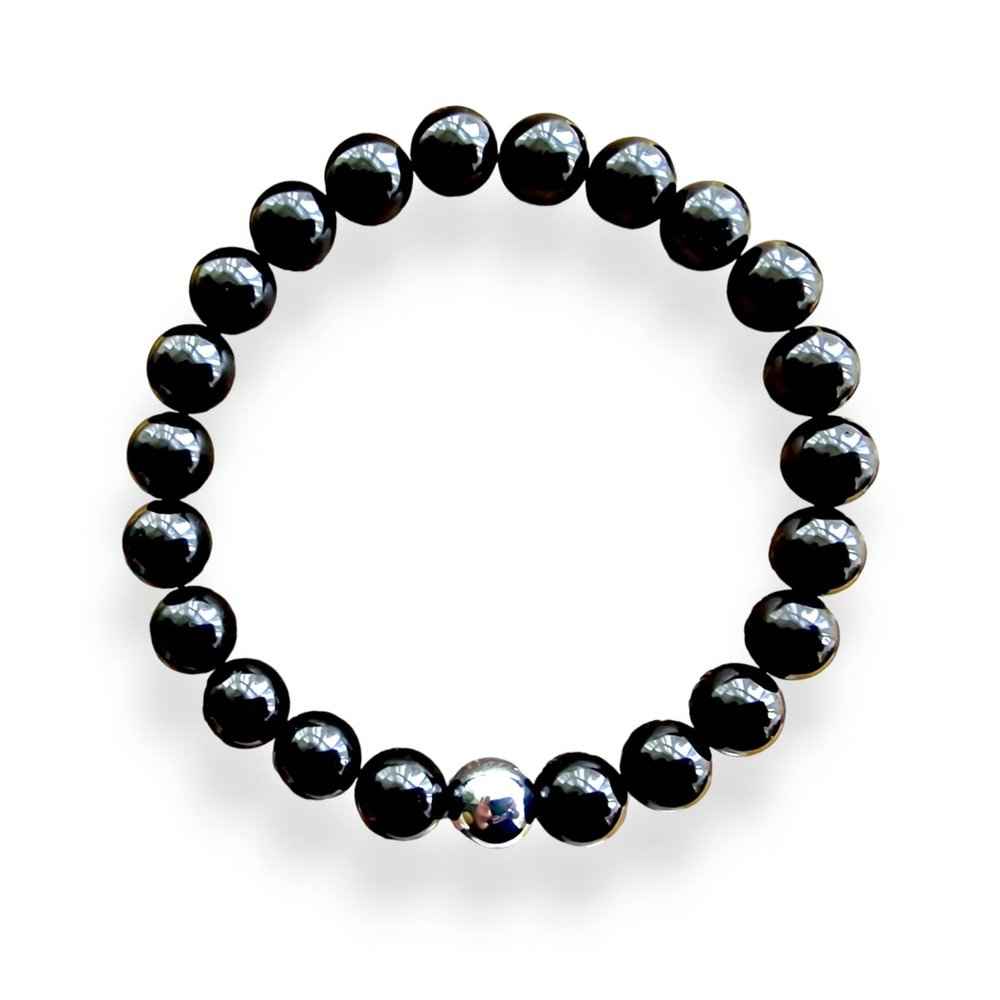
Black Tourmaline's Mohs hardness of 7 to 7.5 makes it durable enough for bracelets, necklaces and rings worn daily. Its deep black colour provides strong visual contrast against silver or gold settings and pairs well with most other stones. It is particularly popular in minimalist and geometric jewellery designs. Browse our Black Tourmaline jewellery and stones.
Tourmaline bracelets
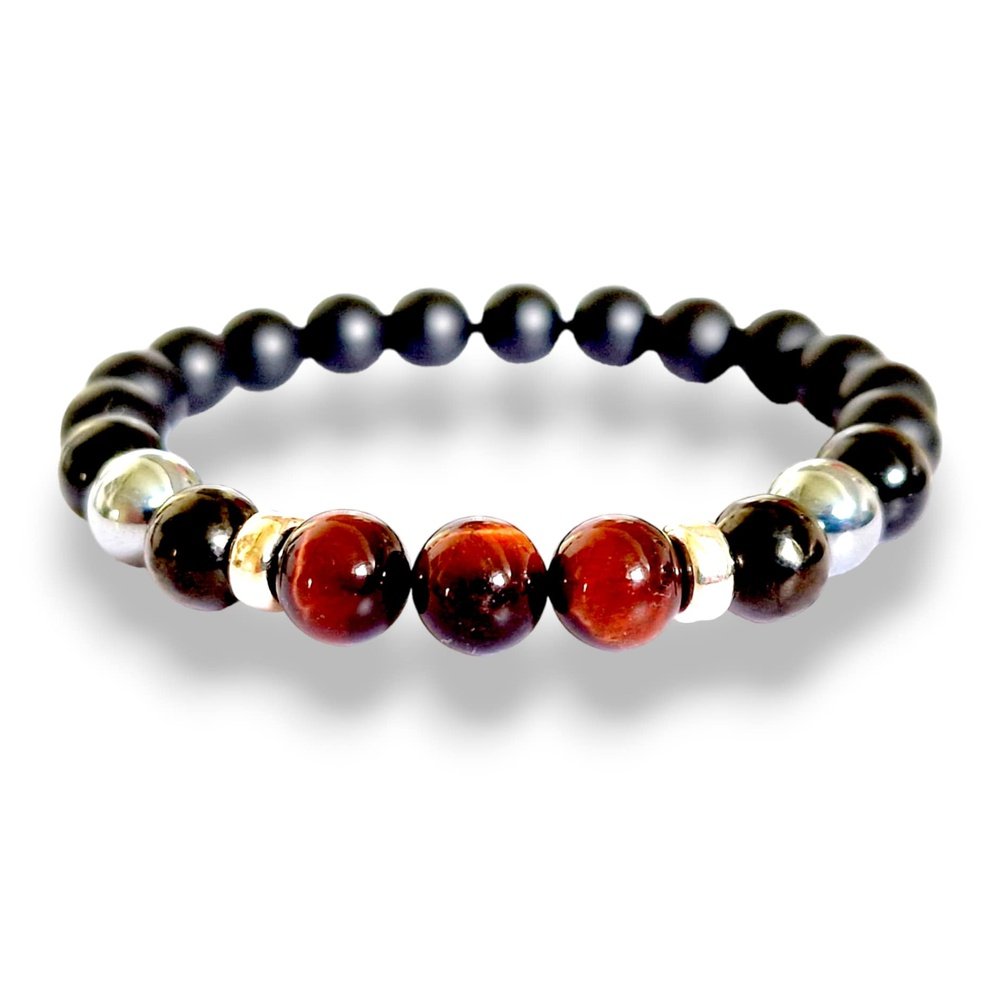
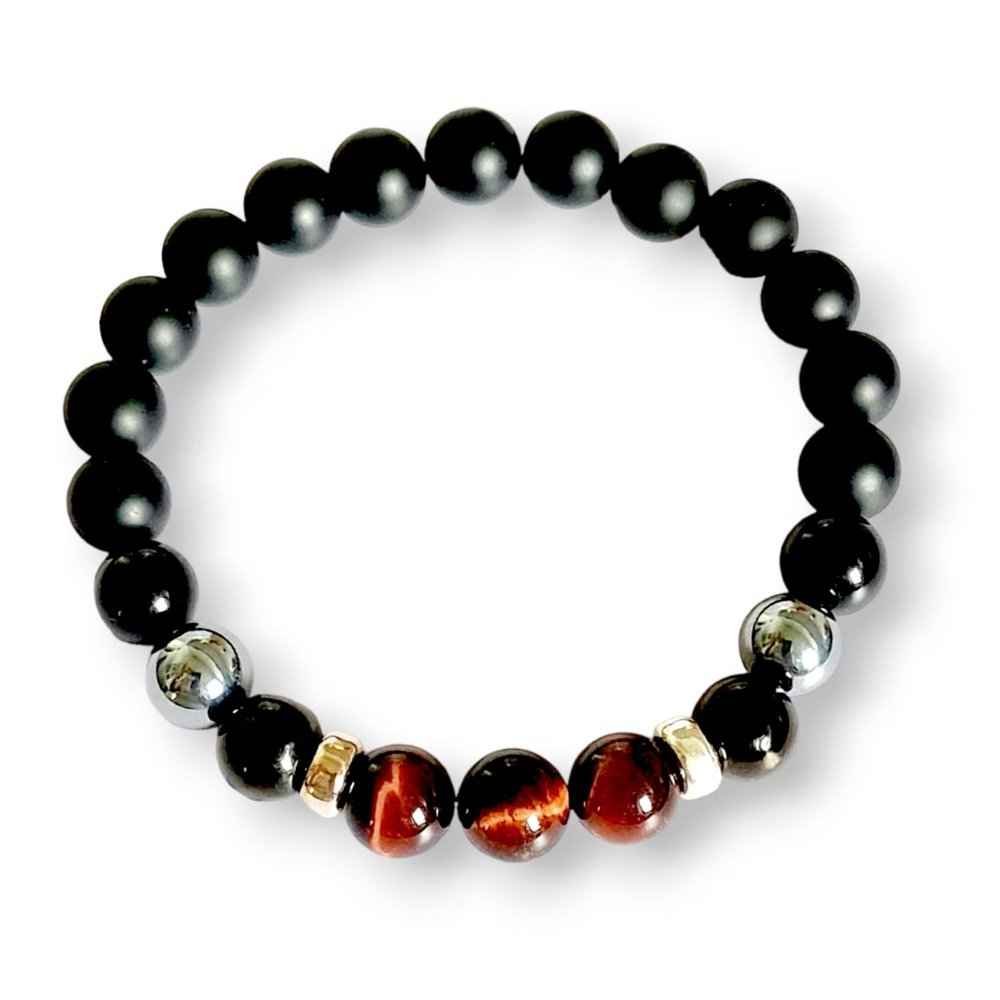
Black Tourmaline round beads (typically 6 mm to 10 mm) are widely used in stretch and knotted bracelets. The striation texture of raw specimens is largely smoothed out during polishing, but the deep black colour remains consistent. It is also used in chip bracelets and alongside other dark stones such as Black Onyx and Obsidian.
Tourmaline necklaces and pendants
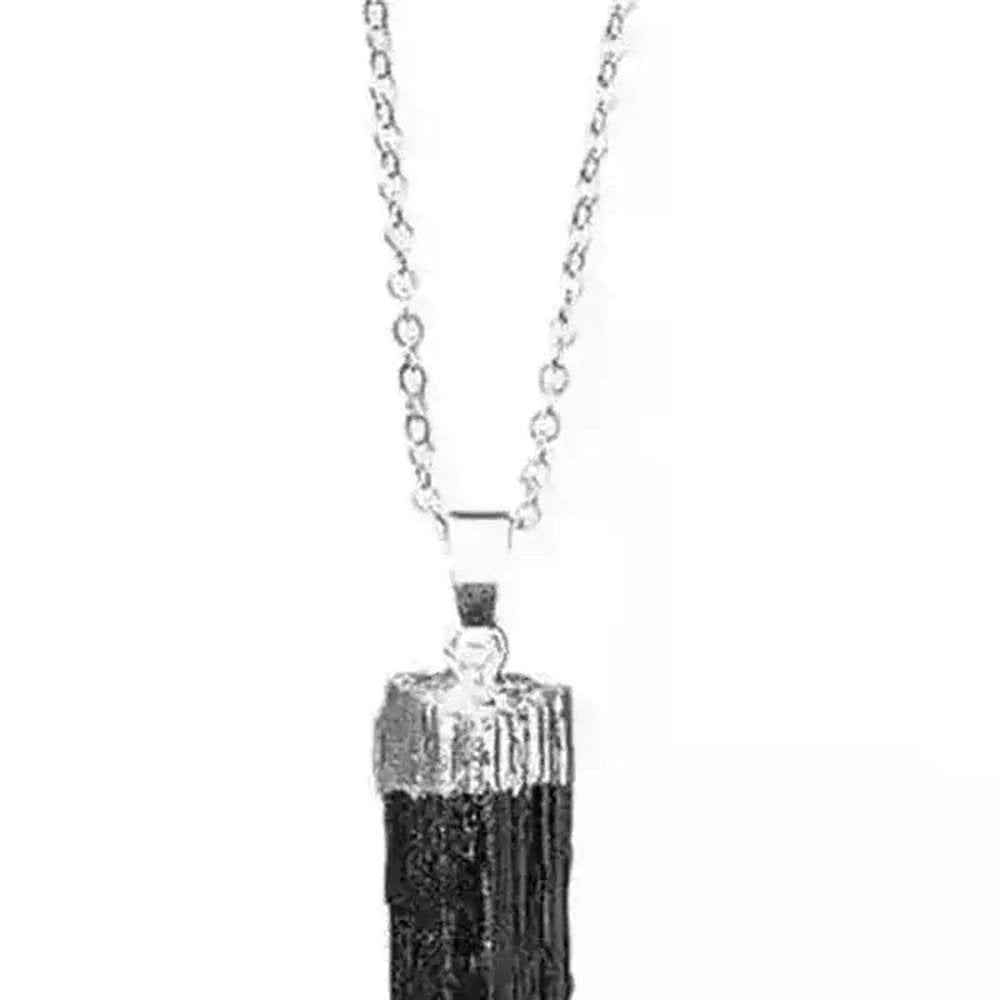
Raw Tourmaline points and tumbled Tourmaline are both used as pendant stones, often wire-wrapped in sterling silver. The natural column or rod shape of raw Schorl crystals suits point pendant designs particularly well. View our raw black tourmaline pendant necklace on a sterling silver chain.
Identifying genuine Black Tourmaline
Genuine Black Tourmaline is opaque and has slight surface variations, especially in raw form where striations are clearly visible. Polished beads are consistently black with a glassy surface. It can be distinguished from Black Onyx (a chalcedony variety) by its slightly warmer tone and, in raw form, by its striated column structure. Dyed black stones may fade at edges or chips over time.
Three black stones compared
Black tourmaline
- Type: boron silicate mineral
- Mohs: 7 to 7.5
- Lustre: vitreous (glassy)
- Key ID: striations on raw crystal faces
Black onyx
- Type: chalcedony (quartz)
- Mohs: 6.5 to 7
- Lustre: waxy to dull
- Key ID: uniform smooth surface when polished
Obsidian
- Type: volcanic glass
- Mohs: 5 to 5.5
- Lustre: very glossy
- Key ID: conchoidal (shell-like) fracture
All three look deep black when polished. Raw form is the most reliable way to tell them apart by eye.
Black Tourmaline as a collector's specimen
Raw Schorl crystals, particularly large prismatic columns or matrix specimens (crystals still attached to the host rock), are popular with mineral collectors. Specimens from Brazilian pegmatites are especially well-formed and widely available. When evaluating a specimen, look at crystal clarity, lustre, size and how clearly the characteristic striations are defined.
Popular black tourmaline pieces
A small selection of customer favourites. Swipe to see more.


How to care for Black Tourmaline jewellery
Cleaning
Black Tourmaline is water-safe and can be cleaned with a damp cloth or mild soapy water. Rinse thoroughly and dry completely after cleaning. Avoid ultrasonic cleaners for pieces with visible inclusions or natural fissures, as the ultrasonic action can worsen micro-cracks within the stone.
Storage
Store Black Tourmaline pieces separately from softer stones to avoid scratching them: its Mohs hardness of 7 to 7.5 will scratch most stones below this level. Keep pieces away from prolonged direct sunlight, though Black Tourmaline is not particularly prone to UV fading given its opaque black colour.
Durability for everyday wear
With a Mohs hardness of 7 to 7.5, Black Tourmaline is one of the more durable stones used in everyday jewellery. It resists most household chemicals and does not react to normal water or mild soap. Remove jewellery before heavy physical work or contact sports to avoid sharp impacts that could chip or fracture the stone. For full jewellery care guidance, see our article: How to Clean Crystal Jewellery Safely.
Frequently asked questions
What are the vertical ridges on Black Tourmaline?
The parallel ridges running along the length of raw Tourmaline crystals are called striations. They are a structural feature of the trigonal crystal system in which Tourmaline grows, not surface damage or wear. Striations are most clearly visible on raw and rough specimens. Polished beads have these largely smoothed away during cutting and finishing.
Can Black Tourmaline go in water?
Yes, Black Tourmaline is water-safe and can be rinsed or cleaned with water. It has a Mohs hardness above 7 and does not dissolve or react with plain water. Avoid prolonged soaking, which is unnecessary for cleaning and may affect metal settings on jewellery pieces.
Is Black Tourmaline the same as Obsidian?
No. Obsidian is a volcanic glass with a conchoidal fracture and no crystalline structure. Black Tourmaline is a true boron silicate mineral with a defined crystal system. Obsidian has a lower Mohs hardness (5 to 5.5) and is more brittle than Tourmaline.
What is the difference between Black Tourmaline and Black Onyx?
Black Tourmaline (Schorl) is a boron silicate with Mohs hardness 7 to 7.5 and a striated raw structure. Black Onyx is a chalcedony (microcrystalline quartz) with Mohs hardness around 6.5 to 7 and a uniformly smooth, waxy surface. Both appear deep black when polished, making them difficult to distinguish by eye in bead form.
Where does Black Tourmaline come from?
Major commercial sources include Brazil (Minas Gerais), Sri Lanka, Nigeria, Namibia, Pakistan and the United States. Brazilian Schorl from pegmatite deposits is among the most widely available in the UK market.
Where can I buy Black Tourmaline jewellery in the UK?
Crystals Healing UK offers Black Tourmaline bracelets, necklaces and tumbled stones, with free UK delivery on orders over £30. Browse our Tourmaline collection for the full range.