Tiger's Eye is one of the few natural stones where the most interesting thing about it is not the colour, the rarity or the price. It is what the stone does with light. Cut it correctly and a narrow band of reflected brilliance slides across the surface as the stone moves. This guide covers everything: what Tiger's Eye actually is, why that optical effect happens, how to tell a quality piece from an average one, the three colour varieties and how to wear it.
The optical effect that defines Tiger's Eye: chatoyancy
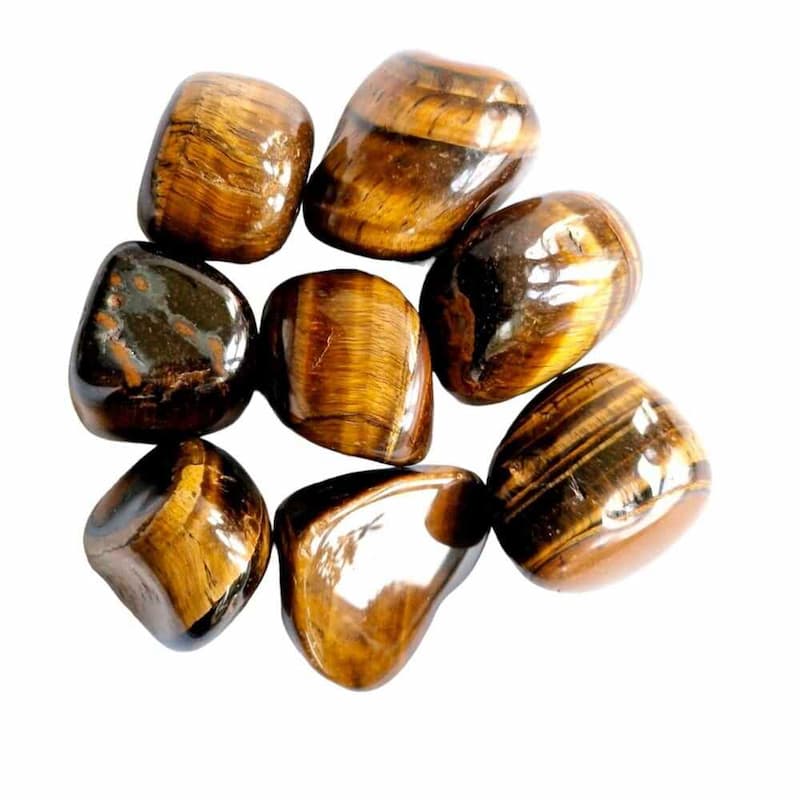
Chatoyancy (from the French "oeil de chat", meaning cat's eye) is an optical phenomenon produced when thousands of parallel, needle-like fibres inside a stone reflect light simultaneously. In Tiger's Eye, those fibres run in a single direction through the entire stone. When cut as a smooth, domed cabochon and held under a directional light source, the fibres reflect light into one concentrated band that appears to sit on the surface and moves as the viewing angle changes.
The quality of this effect depends entirely on the fibres: how parallel they are, how densely packed, and how uniformly they run through the stone. The finest Tiger's Eye pieces show a sharp, bright, well-centred band that travels clearly from one edge to the other as the stone tilts. Lower quality pieces show a diffuse glow rather than a defined line.
Tiger's Eye is one of only a handful of minerals capable of producing this effect. Among stones used in everyday jewellery at accessible prices, it is the most widely available chatoyant stone.
How the moving band forms
- Structure: Parallel fibres inside the stone
- Light: All the fibres reflect light at once
- Result: A bright band across the surface
- Movement: The band shifts as you tilt the stone
- Quality: A sharp, defined band beats a diffuse glow
How Tiger's Eye forms: the pseudomorphism story
Tiger's Eye begins its life as a completely different mineral. The original material is crocidolite, a blue fibrous form of asbestos (sodium iron silicate) that grows as long, thin, parallel crystal fibres packed tightly together. Over hundreds of millions of years, groundwater carrying dissolved silica percolates through the crocidolite. Molecule by molecule, the crocidolite fibres are replaced by silica (quartz), while iron oxide from the original mineral is left behind. This process is called pseudomorphism: the new mineral takes the exact physical shape and fibre structure of the original.
The result is quartz with the fibrous internal architecture of the original asbestos crystal. The iron oxide provides the golden-brown colour. The preserved fibre alignment produces the chatoyancy. Tiger's Eye is, in a precise mineralogical sense, a false form: quartz shaped exactly like the crocidolite it replaced.
This is why Tiger's Eye looks and behaves so differently from other quartz varieties. Amethyst and clear quartz form as open crystal lattices; rose quartz forms as a granular mass. Tiger's Eye has a parallel fibre structure found in almost no other quartz material.
Physical properties at a glance
- Chemical composition: SiO2 with iron oxide; pseudomorphic replacement of crocidolite
- Mohs hardness: 6.5 to 7, suitable for bracelets, necklaces and pendants
- Optical effect: Chatoyancy (cat's eye), visible only in cabochon cut
- Lustre: Silky on fibre surfaces; vitreous (glassy) on cut cross-sections
- Transparency: Opaque
- Colour: Golden-brown with dark banding in standard form
- Primary sources: South Africa (Northern Cape, world's largest deposit), Western Australia, India, Namibia, Burma, Brazil
- First described: 1892 by J.D. Dana; named for visual resemblance to a real tiger's iris
The name: why Tiger's Eye?
The stone was formally described by mineralogist James Dwight Dana in 1892. The name is straightforwardly descriptive: the warm golden-brown banding and the moving band of reflected light together closely resemble a tiger's iris, which is amber-gold with a dark centre that catches and redirects light as it narrows and widens.
Before Dana's classification, the stone had been in use for centuries. Roman soldiers are said to have carried Tiger's Eye into battle, drawn to its watchful-eye appearance. Ancient Egyptians inlaid it into the eyes of carved statues, and in ancient China it was worn as a decorative ornament. All of these uses responded to the stone's visual resemblance to a real, watchful eye rather than to any mineralogical knowledge.
Today almost all commercial Tiger's Eye comes from South Africa's Northern Cape province, which sits above one of the world's largest crocidolite formations and has dominated global production since the early 20th century.
Tiger's Eye colour varieties
Tiger's Eye: three colour varieties
-
Golden Tiger's EyeWarm gold-brown bands from iron oxideMost widely available. South Africa, India, Australia
-
Red Tiger's EyeRicher red-brown, deepened by heat treatmentSame mineral, hardness and band
-
Blue Tiger's Eye (Hawk's Eye)Grey-blue, where crocidolite is not fully replacedSame hardness and band
All three show the moving band when cut as a domed cabochon, and share the same Mohs hardness.
Golden Tiger's Eye
The standard and most abundant variety. Warm brown and gold banding produced by iron oxide from the pseudomorphism process. The contrast between dark and light bands makes the chatoyant effect most visible. Pairs well with sterling silver, brass and gold-tone settings. Browse our Tiger's Eye jewellery collection.
Red Tiger's Eye
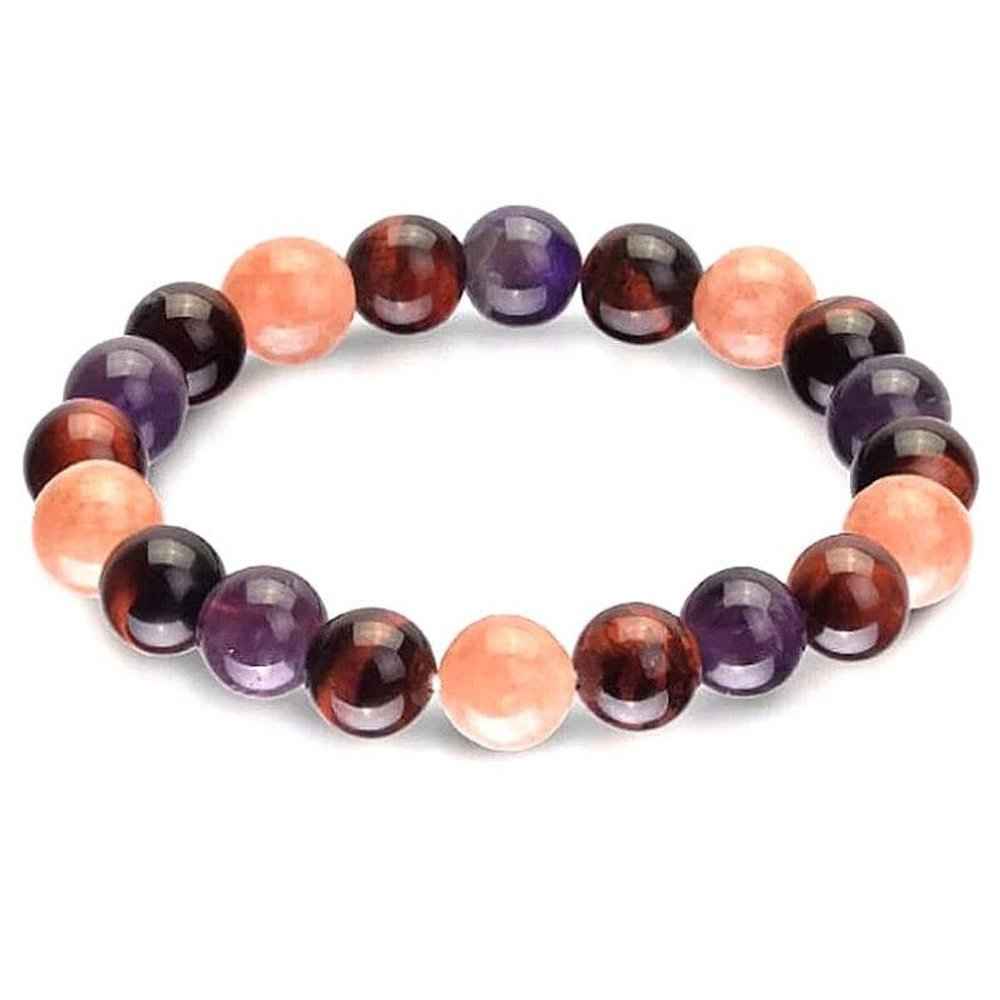
Produced by heat-treating golden Tiger's Eye, which further oxidises the iron and shifts the colour to a rich red-brown. The process does not affect hardness or chatoyancy. Popular in jewellery designs where strong contrast is wanted, particularly alongside obsidian or dark tourmaline. Often combined with golden Tiger's Eye in mixed bracelets. For a full dedicated guide, see our Red Tiger's Eye article.
Blue Tiger's Eye (Hawk's Eye)
Where the original crocidolite fibres have not been fully replaced, the stone retains a grey-blue colour. It shows identical chatoyancy to golden Tiger's Eye but with a cooler, silvery-blue moving band. Less common than golden Tiger's Eye and pairs especially well with sterling silver. For a full dedicated guide, see our Blue Tiger's Eye article.
Mixing varieties in jewellery
All three varieties share the same Mohs hardness and internal structure, so they wear consistently together. A mixed Tiger's Eye bracelet with golden, red and blue beads gives three tones of chatoyancy on the same piece. View our Tiger's Eye collection for single-variety and mixed options.
How to assess Tiger's Eye quality: what to look for
Tiger's Eye varies significantly in quality. Most buyers focus only on colour, but since chatoyancy is the defining feature, it deserves equal attention.
1. Chatoyancy sharpness
Hold the stone or bracelet under a single directional light and tilt slowly. High-quality Tiger's Eye shows a narrow, well-defined band travelling clearly across the full surface. Lower quality pieces show only a broad diffuse glow with no clear line. This is the most important quality factor and the one most commonly overlooked when buying online.
2. Banding definition
The alternating dark and light bands running through the stone should be visible and distinct. Very uniform material with little visible banding produces a less interesting visual effect. Well-defined banding adds depth and makes chatoyancy more dramatic by contrast.
3. Colour consistency in a set
In a bracelet, some natural colour variation between beads is expected. Each bead is cut from a different part of the stone. Extreme variation, where some beads are almost yellow and others are very dark, usually indicates inconsistently sourced material.
4. Surface finish
Polished Tiger's Eye should have a smooth, even surface with no visible scratches, flat spots or pit marks. The silky lustre on fibre surfaces should be uniform. Rough or dull patches indicate poor finishing.
5. Spotting glass and plastic imitations
Tiger's Eye is occasionally imitated by fibreglass or dyed plastic. Genuine Tiger's Eye is heavier than glass of the same size (specific gravity 2.64 to 2.71, versus around 2.5 for most glass). It feels cooler to the touch than plastic, which warms up quickly in the hand. Under magnification, genuine Tiger's Eye shows actual parallel fibres running through the stone; glass imitations show only a surface shimmer with no internal structure. The chatoyancy in genuine Tiger's Eye travels fully across the stone; in cheap glass it tends to be static or barely visible.
Shop Tiger's Eye jewellery at Crystals Healing UK
Golden, red and blue Tiger's Eye bracelets, necklaces and loose stones. Hand-selected and packaged in the UK, free delivery on orders over £30.
View Tiger's Eye collection All crystal jewelleryTiger's Eye in jewellery
Why cabochon cut is essential
Tiger's Eye must always be cut as a smooth, domed cabochon to display chatoyancy. A flat cut reduces the effect; a faceted cut eliminates it entirely. The dome allows light to reflect across the full fibre width simultaneously, concentrating it into the moving band. Any piece described as "faceted Tiger's Eye" is either mislabelled or uses a different material.
Bracelet bead sizes: 6 mm, 8 mm and 10 mm
Round Tiger's Eye beads come in three common bracelet sizes. At 6 mm, beads give a lighter, more delicate look suited to smaller wrists (under 16 cm) and stacking styles. At 8 mm, the most common size, beads suit most wrist sizes with a good balance of chatoyancy visibility and proportion. At 10 mm, beads make a bolder statement and are popular in men's bracelets, where the larger surface area makes the chatoyant effect more visible on the wrist.
Tiger's Eye for men's jewellery
Tiger's Eye is one of the most popular stones in men's crystal jewellery. Its warm earth-tone colouring is understated rather than decorative, and the chatoyant optical effect provides visual interest without being ostentatious. It is widely used in men's bracelets (8 mm and 10 mm beads) and in sterling silver pendant necklaces, and it suits both casual and dressed-up wear. Browse our men's crystal jewellery collection for Tiger's Eye options alongside obsidian, pyrite and tourmaline combinations.
Tiger's Eye pendants
Large oval cabochons (18 mm x 25 mm or bigger) are the best pendant form because the wider surface lets the chatoyant band travel clearly from edge to edge. Wire-wrapped and bezel-set designs both work well. The opaque, earthy tone pairs well with sterling silver, which provides contrast without competing with the warm colour of the stone.
Tiger's Eye as a display stone
Polished slabs, spheres and large tumbled pieces work well for home display. A Tiger's Eye sphere shows chatoyancy across its entire round surface, making it visually dynamic as the light changes throughout the day. Place it near a lamp or on a well-lit shelf to maximise the optical effect.
What pairs well with Tiger's Eye
Tiger's Eye's warm earth tone works with a specific set of other stones. In bracelets, Mohs compatibility matters because beads rub against each other over time:
- Pyrite (Mohs 6 to 6.5): Metallic gold against warm brown. A classic combination for men's bracelets. Pyrite's cubic metallic surfaces contrast sharply with Tiger's Eye's silky banding.
- Obsidian (Mohs 5 to 5.5): Deep black provides sharp contrast. Obsidian is slightly softer, so minor surface contact marks may appear in bracelets over time as a natural result of any mixed-hardness piece.
- Black Tourmaline (Mohs 7 to 7.5): Deep black, opaque and slightly harder than Tiger's Eye. A durable pairing with strong visual contrast, popular in mixed dark-stone bracelets.
- Carnelian (Mohs 7): Warm orange-red complements the brown-gold of Tiger's Eye without clashing. Both are quartz varieties, well-matched in durability for everyday bracelets.
- Citrine (Mohs 7): Yellow-to-orange quartz that picks up the warm tones in Tiger's Eye. A lighter, brighter combination than obsidian or tourmaline pairings.
- Lapis Lazuli (Mohs 5 to 6): Deep blue against warm gold-brown. A high-contrast, sophisticated combination used in jewellery since ancient Egypt. Lapis is softer, so best used as pendants rather than bead bracelets where constant bead contact would cause wear.
How to care for Tiger's Eye jewellery
Cleaning
Tiger's Eye is water-safe. Clean with a soft damp cloth or mild soapy water, rinse thoroughly and dry completely. Avoid ultrasonic cleaners, which can worsen micro-fractures along fibre boundaries. Avoid harsh chemicals, bleach and acids.
Sunlight and heat
Tiger's Eye is more stable under UV than colour-sensitive stones like amethyst or rose quartz. Normal indoor and outdoor light does not cause fading. Avoid extreme heat sources, which could affect iron oxide colouration over extended time.
Storage
Store Tiger's Eye separately from harder stones (topaz at 8, sapphire at 9, diamond at 10) that could scratch its surface. A soft pouch or padded compartment is ideal. Its Mohs 6.5 to 7 hardness means it will scratch softer stones such as calcite or selenite if stored together.
Frequently asked questions
What is Tiger's Eye made of?
Tiger's Eye is quartz (SiO2) with iron oxide, formed through the pseudomorphic replacement of crocidolite (blue fibrous sodium iron silicate). Over hundreds of millions of years, the crocidolite fibres are replaced molecule by molecule by quartz while iron oxide is left behind. The preserved fibre structure produces chatoyancy; the iron oxide provides the golden-brown colour.
Why does Tiger's Eye have a moving band of light?
The moving band is chatoyancy, produced by thousands of parallel microscopic fibres inherited from the original crocidolite structure. Cut as a domed cabochon, these fibres reflect a directional light source simultaneously into a concentrated band that shifts as the viewing angle changes. The effect only works in cabochon cut; faceted cutting destroys it.
What is the difference between Tiger's Eye and Hawk's Eye?
Hawk's Eye (Blue Tiger's Eye) forms where the crocidolite has not been fully replaced, retaining the original blue-grey colour. Golden Tiger's Eye is fully replaced and coloured by iron oxide. Both show chatoyancy in cabochon cut. They are the same type of stone at different stages of pseudomorphic replacement. Full guide: Blue Tiger's Eye (Hawk's Eye).
Is Red Tiger's Eye natural?
Most commercial Red Tiger's Eye is heat-treated golden Tiger's Eye. The heat deepens iron oxidation to red-brown. Some natural red Tiger's Eye exists but is less common. Heat treatment does not affect hardness or chatoyancy and is standard practice in the gem trade. Full guide: Red Tiger's Eye.
How do I tell if Tiger's Eye is genuine?
Genuine Tiger's Eye shows actual parallel fibres under magnification, feels cooler and heavier than glass or plastic of the same size, and has slight surface texture variation. Glass imitations show only a surface shimmer with no internal fibre structure and feel lighter. The chatoyancy in genuine Tiger's Eye shifts clearly across the full stone; in cheap glass it is static or barely visible.
Can Tiger's Eye go in water?
Yes. Tiger's Eye has Mohs hardness 6.5 to 7 and does not react with plain water. Clean briefly with water if needed, rinse and dry. Avoid prolonged soaking and salt water.
Is Tiger's Eye good for men's jewellery?
Tiger's Eye is one of the most popular stones in men's crystal jewellery. Its warm brown-gold colouring is understated and the chatoyancy adds visual interest. It works well in 8 mm and 10 mm bracelets and sterling silver pendant necklaces, often combined with obsidian, pyrite or black tourmaline. Browse our men's crystal jewellery.
Where can I buy Tiger's Eye jewellery in the UK?
Crystals Healing UK offers Tiger's Eye bracelets, necklaces and stones in golden, red and blue varieties, hand-selected and packaged in the UK with free delivery on orders over £30. Browse our Tiger's Eye collection, our guides for Red Tiger's Eye and Blue Tiger's Eye, or the full crystal jewellery range.