Quick answer
Smoky quartz is the brown to grey-black variety of quartz, coloured by natural radiation acting on tiny aluminium traces in the crystal. It is hard and water-friendly at 7 on the Mohs hardness scale. One thing worth knowing as a buyer: a great deal of very dark "smoky quartz" on the market is clear quartz that has been artificially irradiated, so honest description matters.
On this page
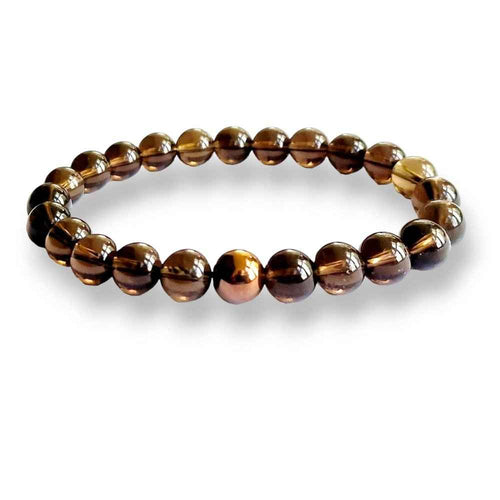
Smoky quartz is the gentle smoke-coloured cousin of clear quartz, ranging from a pale, hazy grey-brown to a deep near-black. It is hard-wearing, widely available and a favourite for both jewellery and display pieces. It also has an honest story worth telling, because a lot of what is sold as smoky quartz has been treated. This guide explains what smoky quartz actually is, how to spot natural from irradiated stones, the traditional names you will come across, and how to care for it.
What is smoky quartz?
Smoky quartz is simply quartz (silicon dioxide) in a smoky brown to grey or near-black shade. The colour comes from a natural process: over very long periods, low-level radiation from surrounding rock acts on tiny traces of aluminium in the crystal, creating what gemmologists call colour centres that absorb light and produce the smoky tone.
Like all quartz, it sits at 7 on the Mohs scale, so it is hard, durable and a sensible choice for everyday jewellery. It is usually transparent to translucent, and good natural material often shows soft colour zoning or small inclusions rather than a flat, uniform black.
It is found in many parts of the world, with major sources in Brazil, Madagascar and the Swiss Alps, and a famous historic source in Scotland that gave the stone one of its best-known names, covered further below.
Natural vs irradiated smoky quartz
This is the part most guides skip, so it is worth being clear. Because it is easy to turn cheap colourless quartz a deep smoky colour with artificial irradiation, large amounts of treated quartz are sold as smoky quartz, often without the treatment being mentioned. The treated material is real quartz, but its colour is produced in a lab rather than over geological time.
You cannot prove the difference at home without lab equipment, but some clues help. Natural smoky quartz tends to show an earthy, sometimes uneven brown-grey, and may carry small inclusions. Heavily irradiated stones are often an intense, uniform near-black, can be unusually clean, and sometimes show a stark black tone over a pale base. Artificially coloured quartz can also fade noticeably faster in strong light.
There is nothing wrong with treated stones in themselves, as long as they are described honestly. Our approach is to label material clearly so you know what you are buying. For the same honest approach to identification, see our guide on how to tell if amethyst is real.
Cairngorm and morion: the names you will see
Smoky quartz carries a couple of traditional names that are useful to recognise. Cairngorm is the name for the yellow-brown to smoky variety historically found in the Cairngorm Mountains of Scotland. It has a long place in Scottish jewellery, where it was set into brooches, kilt pins and the handles of traditional dirks, and the name is still used today for that warm, smoky Scottish style.
At the other end of the scale, morion is the term for very dark, almost opaque black smoky quartz. Both are the same mineral as ordinary smoky quartz, simply at different depths of colour, so knowing the names helps you understand a label rather than pay for anything fundamentally different.
Does smoky quartz fade, and is it water-safe?
As a quartz at hardness 7, smoky quartz is durable and copes well with water, so it is easy to look after. The main thing to watch is strong, prolonged light, which can gradually lighten the smoky colour. A few habits keep it looking its best:
- Water is fine, soaking is unnecessary. A quick rinse and a soft cloth are all it needs; there is no benefit to leaving it submerged.
- Avoid prolonged strong sunlight. Long spells of intense sun can lighten the colour over time, and a rapid fade can be a sign the colour was artificially produced.
- Keep away from harsh chemicals. Cleaning products and strong jewellery dips can dull the polished surface.
- Store it separately. A soft pouch or lined box stops harder stones scratching it and protects the finish.
For a wider view of which stones tolerate water, see our water-safe crystals guide, and our note on stones that can fade in sunlight. To clean a finished piece safely, see cleaning crystal jewellery safely.
Choosing smoky quartz jewellery
Smoky quartz is hard, affordable and easy to wear, with a warm neutral colour that suits most outfits. A few pointers help you buy well:
- Favour an earthy, natural tone. A soft, slightly varied brown-grey often points to natural colour, while an intense uniform black may be heavily treated.
- Ask about treatment. A trustworthy seller will tell you whether a stone is natural or irradiated; both are fine when described honestly.
- Check the polish and clarity. An even polish and tidy drill holes on beads point to careful workmanship.
- Great for everyday wear. At hardness 7 it suits rings, bracelets and pendants alike.
If you are buying a bracelet, our crystal bracelet size guide helps you get the fit right first time.
Shop the collection
Genuine stones, clearly described and packed with care.
Crystal Bracelets Crystal Necklaces Men's Jewellery Tumbled StonesFrequently asked questions
What gives smoky quartz its colour?
Natural radiation from surrounding rock acts on tiny aluminium traces in the quartz over long periods, creating colour centres that produce the smoky brown to grey-black tone.
Is a lot of smoky quartz irradiated?
Yes. Colourless quartz is easily turned smoky by artificial irradiation, and much of it is sold without disclosure. It is still real quartz, but its colour is lab-made, so honest labelling matters.
What are Cairngorm and morion?
They are traditional names for smoky quartz. Cairngorm is the yellow-brown Scottish variety used in Scottish jewellery, while morion is very dark, almost black smoky quartz. Both are the same mineral.
Can smoky quartz go in water and sunlight?
Water is fine briefly, as it is hardness-7 quartz. Strong, prolonged sunlight is best avoided, since it can gradually lighten the colour, and a fast fade can indicate artificially produced colour.