What is agate?
Agate is a banded variety of chalcedony, which is itself a microcrystalline form of quartz (silicon dioxide, SiO2). It is recognised by its layered banding and a waxy to glassy lustre, in colours from warm browns and reds to cool blues and greys. Agate forms when silica-rich fluids seep into cavities in volcanic and other rocks and deposit in successive layers over long periods. Because each layer builds up slightly differently, every piece of agate is visually unique. At Mohs hardness 6.5 to 7 it is hard and durable, which is why it has been used for jewellery and carving for thousands of years.

The name comes from the Achates river in Sicily (now the Dirillo), where the ancient Greeks reportedly first found it. This guide covers what agate is, the popular types, how to tell natural from dyed, its history, and how to choose and care for it.
Physical properties at a glance
- Mineral: Chalcedony (microcrystalline quartz, SiO2), the banded variety
- Colour: Wide range, browns, reds, blues, greys, greens, often banded
- Mohs hardness: 6.5 to 7, hard and durable
- Lustre: Waxy to vitreous
- Transparency: Translucent to opaque, often translucent at the edges
- Formation: Silica layers deposited in rock cavities
- Main sources: Brazil, Uruguay, India, Mexico, the USA and many others
Agate, jasper and chalcedony: how they relate
These names confuse a lot of buyers, but the relationship is simple. All three are microcrystalline quartz:
- Chalcedony: the family name, a solid, usually single-colour translucent quartz.
- Agate: chalcedony with visible banding or patterning, usually translucent.
- Jasper: chalcedony that is opaque and densely coloured, often patterned but not translucent.
So agate and jasper are close cousins; the quick test is translucency and banding. See our jasper collection to compare.
Popular types of agate
Popular types of agate
-
Banded agateConcentric layers
-
Moss agateGreen inclusions
-
Blue lace agatePale blue bands
-
Crazy lace agateBusy swirls
-
Druzy agateSparkling crust
All are natural banded or patterned chalcedony (Mohs 6.5 to 7). No two pieces are identical. Very bright blue, pink or purple agate slices are usually dyed.
- Banded agate: the classic look, concentric layers in browns, greys and reds (Botswana and Brazilian agate are well known).
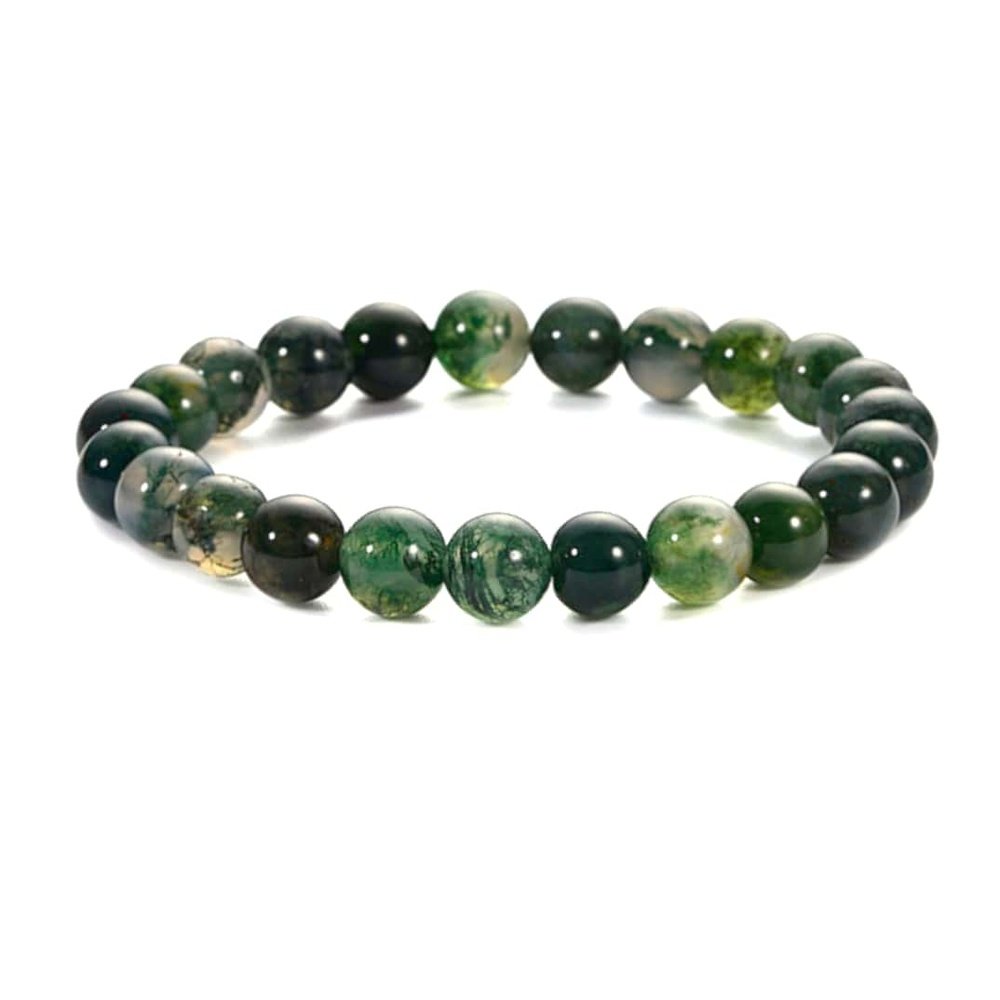
- Moss agate: translucent with green, plant-like inclusions. Technically not banded, but always sold as agate. See our moss agate bracelet.
- Blue lace agate: soft, pale blue with delicate banding.
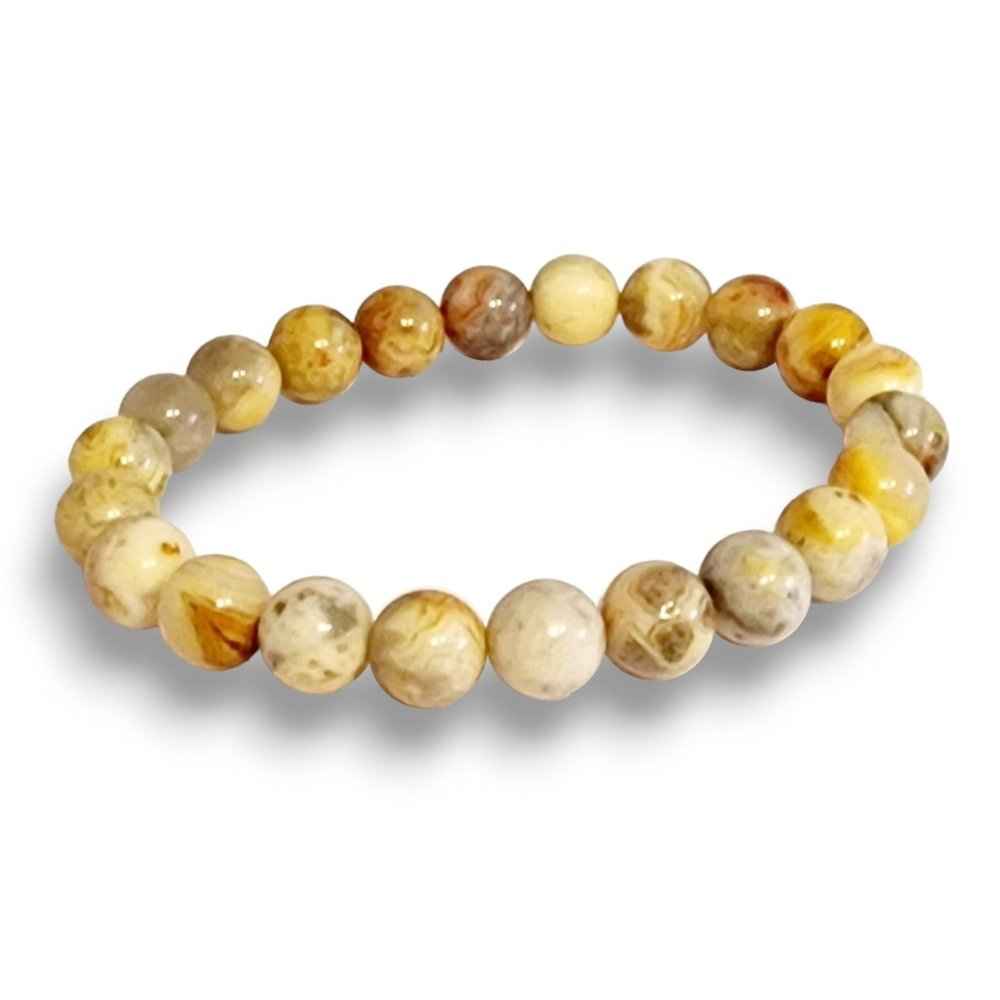
- Crazy lace agate: busy, swirling multi-coloured patterns. See our crazy lace agate bracelet.
- Druzy agate: a crust of tiny sparkling crystals over agate, popular in pendants. See our druzy agate necklace.
Natural vs dyed agate
This is the key thing to know before buying. Agate is porous, so it takes dye very well, and a large share of the brightly coloured agate on the market is dyed. Those vivid blue, hot pink, purple and teal agate slices and coasters are almost always dyed; natural agate tends toward earthier browns, greys, soft blues and whites. Dyeing is a normal, long-standing trade practice and is fine when it is disclosed. To buy with confidence:
- Look at the colour: unnaturally vivid, candy-bright or neon colours usually mean dye.
- Check the bands: in dyed agate the colour can pool unevenly along the porous bands, looking too saturated in places.
- Ask the seller: a good seller will tell you whether a piece is natural or dyed.
- Care for dyed pieces: keep dyed agate out of prolonged water and strong sun, as dye can fade or leach.
A long history in art and jewellery
Agate is one of the oldest worked stones. It was carved into seals, beads and ornaments in the ancient Near East and Egypt, and the Greeks and Romans used it for cameos, intaglios, ringstones and carved bowls. From the 16th century, the town of Idar-Oberstein in Germany became a world centre for agate cutting, and it remains associated with the trade today. Banded agate is also the traditional material for the prized "aggie" playing marbles. This long history is part of why agate is so closely linked with fine craftsmanship.
Agate in jewellery and how to choose
At Mohs 6.5 to 7, agate is durable enough for bracelets, pendants and rings. Choose by the look you prefer: a calm banded or moss agate for an understated piece, or a lively crazy lace or sparkling druzy for a statement. Smaller tumbled stones suit daily carry, while slices and druzy pendants make eye-catching display and gift pieces. Browse our bracelets and necklaces.
How to care for agate
- Water: natural agate (Mohs 6.5 to 7) tolerates a brief rinse, then drying. Keep dyed agate dry, as water can affect the dye.
- Chemicals: avoid harsh cleaners, perfume and cosmetics on the stone.
- Sunlight: keep dyed pieces out of prolonged direct sun to prevent fading.
- Storage: wipe with a soft cloth and store away from harder stones to prevent scratching.
For which stones tolerate water, see our water-safe crystals guide.
Frequently asked questions
What is agate?
Agate is a banded variety of chalcedony, a microcrystalline form of quartz (SiO2). It forms in layers inside rock cavities, which gives it its characteristic banding, and it has a Mohs hardness of 6.5 to 7.
What is the difference between agate and jasper?
Both are microcrystalline quartz (chalcedony). Agate is usually translucent and banded, while jasper is opaque and densely coloured. The quick test is translucency: hold it to the light, and agate often glows at the edges.
Is my agate natural or dyed?
Very bright blue, pink, purple or teal agate is almost always dyed. Natural agate tends toward earthy browns, greys, soft blues and whites. Dyed colour can also pool unevenly along the bands. Ask the seller if you are unsure.
How do I identify agate?
Look for banding or patterning, some translucency (especially at the edges), a waxy to glassy polish, and good hardness (it does not scratch easily). Each piece is unique.
Can agate go in water?
Natural agate is fine for a brief rinse, then drying. Keep dyed agate dry, because prolonged water can affect the dye. Avoid soaking and salt water.
Where does agate come from?
Agate is found worldwide. Notable sources include Brazil, Uruguay, India, Mexico and the USA. The exact look varies by region and formation conditions.
Related reading
- Water-Safe Crystals: what can go in water and what to avoid
- Crystal Jewellery Guide: types, meaning and how to choose
- Crystals for Beginners: how to choose, use and care
Shop & downloads
- Agate Crystals and Crystal Jewellery
- Crystal Bracelets and Crystal Necklaces
- Crystal Gifts and New Arrivals
- Free Crystal Care Checklist (PDF) and Water-Safe Crystals Quick Chart (PDF)
Our crystals are sold as decorative natural stones, jewellery and gifts. We make no medical, therapeutic, spiritual or supernatural claims about them. If you have a health concern, please consult a qualified medical professional.