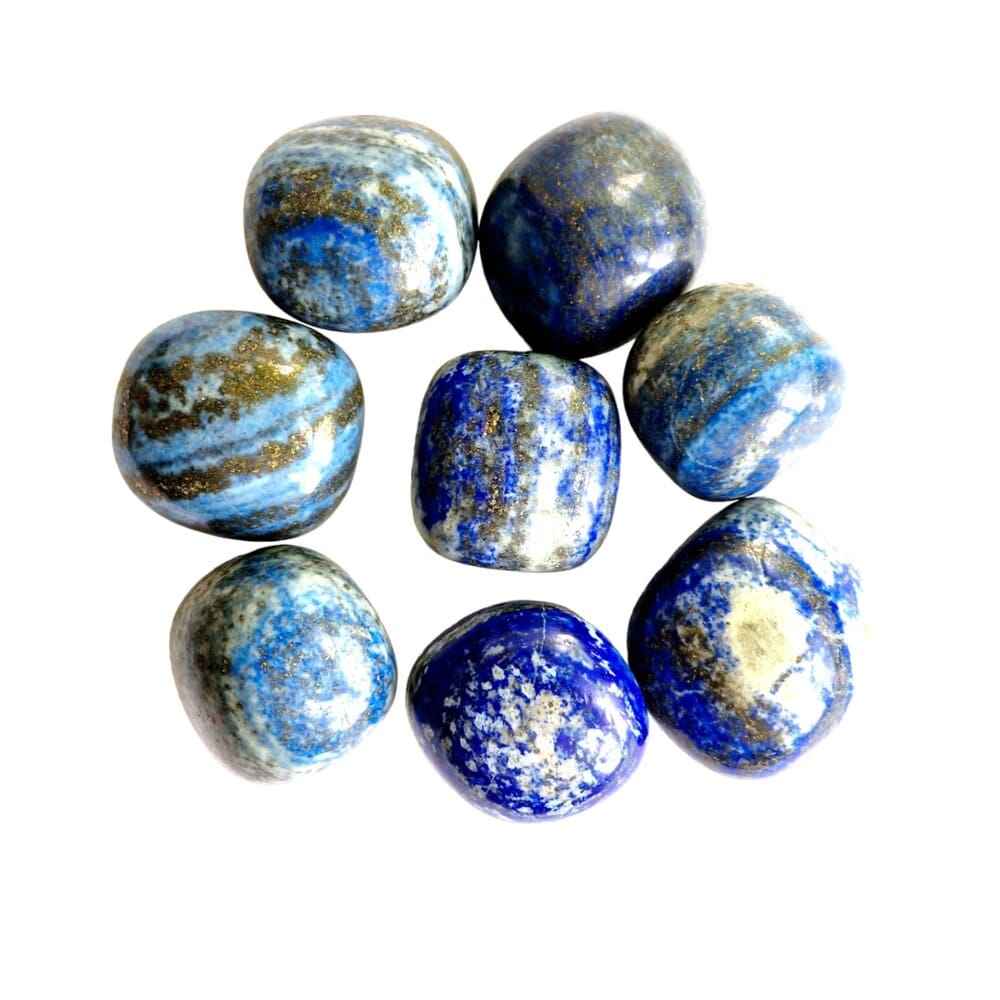
For most of Western art history, blue was the most expensive colour on the painter's palette. The reason was lapis lazuli. Ground into powder, washed and refined, the stone produced ultramarine: a deep, stable, luminous blue that no plant dye or other mineral could replicate. It cost more per ounce than gold. Michelangelo left sections of his paintings unpainted when commissions ran short of funds for ultramarine. Every Renaissance Virgin Mary is dressed in blue because blue was reserved for the most revered figures in the composition. The source of that blue was a single mine in the mountains of Badakhshan, Afghanistan, that has been operating continuously for at least 6,000 years and still supplies the world's finest lapis lazuli today.
This is a guide to what lapis lazuli actually is, why it looks the way it does, how to assess quality, and how to wear it.
What lapis lazuli is: a rock, not a mineral
Most decorative stones are single minerals: amethyst is quartz, tiger's eye is pseudomorphic quartz, moonstone is feldspar. Lapis lazuli is different. It is a metamorphic rock: a naturally occurring mixture of several minerals that formed together under heat and pressure deep in the earth. The appearance of any given piece of lapis lazuli depends on the proportions of those minerals and the conditions of its formation.
The three main components are:
- Lazurite: The primary mineral responsible for the blue colour. Lazurite is a sulfur-bearing sorosilicate of the sodalite group (formula (Na,Ca)8(AlSiO4)6(S,SO4,Cl)2). The deep blue comes from sulfur radical anions (S3-) trapped within the mineral's crystal structure. More lazurite means deeper, more saturated blue.
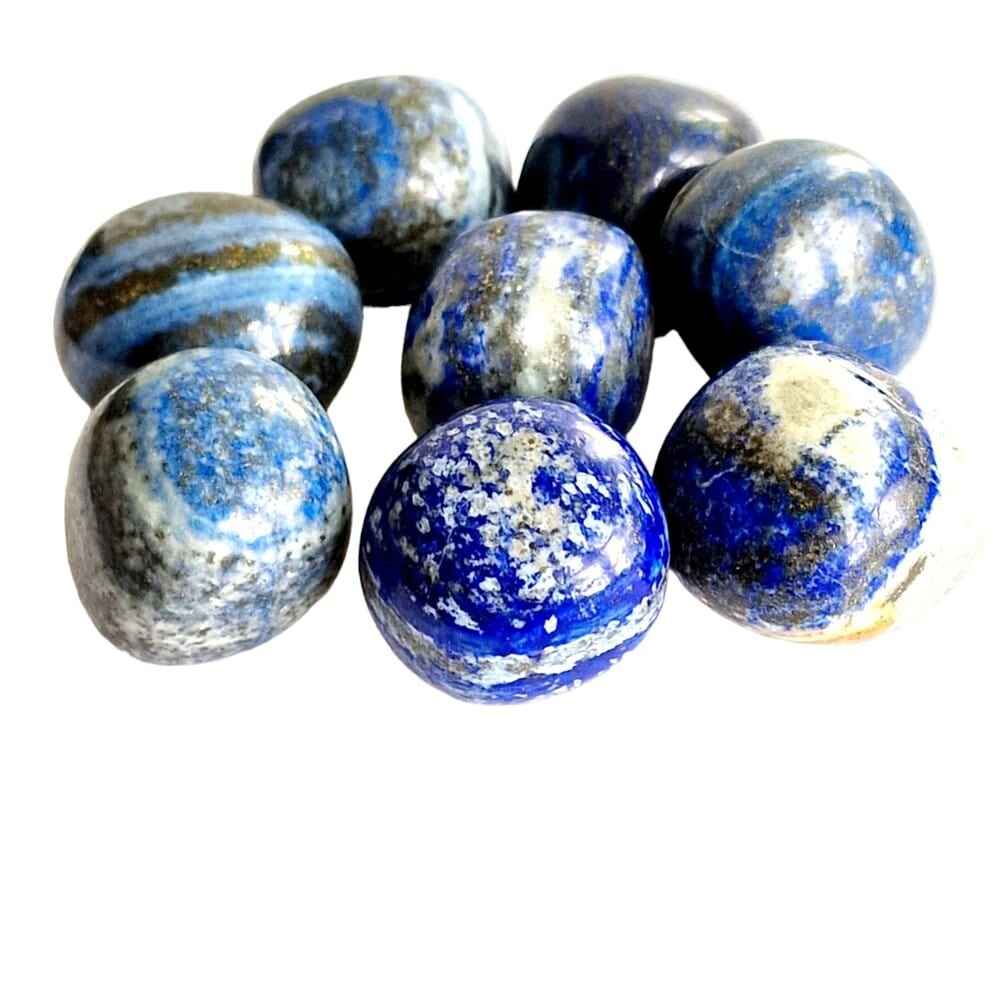
- Pyrite: Iron sulfide (FeS2), responsible for the golden metallic flecks. The presence of pyrite flecks is considered desirable in quality lapis, giving what dealers describe as a "night sky" effect. Too much pyrite can overwhelm the blue and reduce value.
- Calcite: Calcium carbonate (CaCO3), the same mineral as chalk and marble. Appears as white to grey veining or patches. High calcite content is associated with lower quality because it dilutes the blue. However, some collectors appreciate the natural marble-like veining in lapis with more calcite.
Other minerals present in smaller amounts include hauyne (also contributes to blue), sodalite, diopside and mica. The relative proportions of all these components explain why lapis lazuli varies so significantly in appearance from piece to piece.
Lapis lazuli: three mineral components
Lazurite
- Sodium calcium aluminium silicate with sulfur
- Source of the blue colour
- More lazurite means a deeper blue
Pyrite
- FeS2 (iron sulfide)
- Golden metallic flecks
- Fine flecks give a "night sky" look
- Too much pyrite lowers value
Calcite
- CaCO3 (calcium carbonate)
- White to grey veining
- Dilutes the blue
- High calcite means a lower grade
Grade A: deep blue, fine pyrite flecks. Grade B: medium blue, some white veining. Grade C: lighter blue, heavy calcite.
Sar-e-Sang: the mine that never closed
The Sar-e-Sang mine in Badakhshan province, northeastern Afghanistan, has been in continuous operation for approximately 6,000 years, making it one of the oldest known continuously operated mines in human history. The lapis lazuli from this deposit travelled along ancient trade routes to Egypt, Mesopotamia, Greece and Rome millennia before those civilisations began recording their transactions. The deep blue of Tutankhamun's death mask (circa 1323 BCE) came from Sar-e-Sang. The lapis lazuli ground into ultramarine by Renaissance painters came from Sar-e-Sang. The finest lapis lazuli on the jewellery market today largely still comes from Sar-e-Sang.
The mine is located at around 4,000 metres elevation in the Hindu Kush mountains. Mining has historically been conducted in winter, when fires are lit in the tunnels and cold water is thrown on the heated rock face, fracturing the stone to expose the lapis. The deposits lie in marble formations, which is why Afghan lapis tends to have a characteristic appearance: intense deep blue with fine scattered pyrite and relatively little calcite.
A secondary commercial source exists in the Coquimbo region of Chile (the Flor de los Andes deposit), discovered in the 1980s. Chilean lapis tends to be slightly less intensely blue than Afghan material and often contains more calcite, but produces the larger uniform pieces used in carvings, tabletops and decorative objects. Some Argentine material also exists. Afghan lapis commands the highest value in the fine gem trade.
The ultramarine story: why lapis built Western painting
Before synthetic pigments, the colour blue was extremely difficult to produce. Plant sources faded quickly. Most mineral blues were unstable or dull. Lapis lazuli, ground and refined, produced ultramarine: a deep, stable, permanent blue that no other source could match. The name itself means "beyond the sea" in Medieval Latin, referring to the fact that the pigment had to be imported from Afghanistan across the Mediterranean.
Ultramarine was the most expensive artists' pigment in Europe for several centuries. At its peak value in the 15th century, it was worth more per ounce than gold. Commissions for paintings routinely specified quantities of ultramarine in the contract, and the expense was borne by the patron, not the artist. Fra Angelico, Vermeer, Raphael, Titian and Michelangelo all used it. In religious painting, the convention of painting the Virgin Mary's robe in deep blue was not arbitrary: blue was the most precious colour and therefore reserved for the most important subject in the composition.
Synthetic ultramarine was developed in 1826 by French chemist Jean Baptiste Guimet, which caused lapis prices to collapse almost overnight. The stone was no longer needed as a pigment source and its value shifted entirely to jewellery and decorative use, where it has remained ever since.
Physical properties at a glance
- Material type: Metamorphic rock (not a single mineral)
- Primary mineral: Lazurite (source of the blue)
- Secondary minerals: Pyrite (golden flecks), calcite (white veining)
- Colour: Deep blue to blue-violet; varies significantly by quality and source
- Mohs hardness: 5 to 6, softer than most quartz-based stones
- Lustre: Waxy to dull; takes a good polish but scratches more easily than quartz
- Transparency: Opaque
- Primary sources: Afghanistan (Badakhshan, Sar-e-Sang), Chile (Coquimbo), Argentina
- Water sensitivity: Avoid prolonged water exposure; calcite and pyrite content can be affected
How to assess lapis lazuli quality
Lapis lazuli varies enormously in quality, and the factors that determine value are specific to this stone. Unlike gemstones where transparency and cut dominate, lapis quality is assessed almost entirely by colour and mineral balance.
1. Colour depth and saturation
The most important quality factor is the depth and evenness of the blue. Top-grade lapis from Afghan deposits shows a rich, saturated royal to violet-blue with minimal variation across the surface. Lower grade material appears lighter, greyer or more patchy. Deep, even blue throughout the piece indicates high lazurite content and careful material selection.
2. Pyrite quality and distribution
Fine, evenly distributed pyrite flecks add to the stone's visual quality. Large, dense pyrite patches can overwhelm the blue and reduce value. The ideal is a field of fine metallic points across a deep blue background, sometimes described as resembling a night sky. Material with no pyrite at all exists and can be very high quality if the blue is exceptional.
3. Calcite content
White calcite veining and patches dilute the blue and reduce quality in most commercial grading. However, preferences vary: some buyers and jewellers actively seek lapis with natural white veining for a less formal, more organic look. For fine jewellery with a uniform appearance, minimal calcite is preferred. For home display pieces, a more mixed look is often attractive.
4. Afghan vs Chilean origin
Afghan (Badakhshan) lapis is generally considered the finest: deeper blue, finer pyrite distribution, and less calcite than most Chilean material. Chilean lapis tends toward a slightly greyer-blue with more white and often appears in larger uniform pieces. Smaller pieces and beads are more commonly Afghan material; large decorative objects are more often Chilean. Both are genuine lapis lazuli; the quality difference is real but not absolute.
5. Surface finish
Well-polished lapis should have a smooth, even surface with no chalky patches, which indicate that softer calcite areas have not polished to the same finish as the harder lazurite. A good polish across all areas, including calcite-heavy sections, indicates quality preparation.
Lapis lazuli quality grades
-
Grade A AfghanIntense royal blueFine pyrite, minimal calcite. Highest value
-
Grade B AfghanGood blueModerate pyrite, slight calcite. Mid-range value
-
Grade A ChileanMedium blue, coarser pyriteSome calcite veining. Good value for large pieces
-
Lower gradeLighter blue-greyHeavy calcite throughout. Budget jewellery and carvings
Fine pyrite flecks and minimal calcite indicate higher-grade material.
Spotting dyed lapis lazuli and blue howlite
Lapis lazuli is one of the most commonly imitated stones in the jewellery market. Two imitations are particularly widespread:
Dyed howlite
Howlite is a white mineral with grey veining (Mohs 3.5) that is frequently dyed blue and sold as lapis lazuli. It is one of the most common stone imitations in low-priced jewellery. How to identify it:
- No pyrite: Real lapis lazuli almost always contains some pyrite flecks. Dyed howlite never does.
- Weight: Howlite is significantly lighter than lapis lazuli (specific gravity around 2.5 vs 2.7 to 2.9 for lapis).
- Colour in cracks: In dyed howlite, the blue dye concentrates in the natural grey veins, which can appear as unusually dark, intensely coloured lines against a lighter body. In real lapis, the dark areas are lazurite (mineral) and the light areas are calcite.
- Acetone test: A small amount of acetone on a cotton bud wiped across a hidden area will remove dye from howlite but not affect genuine lapis lazuli colour.
- Price: Very low-priced "lapis" is almost certainly howlite. Genuine quality lapis has a meaningful cost per bead.
Dyed jasper and synthetic material
Some dyed jasper and synthetic glass are also sold as lapis lazuli. Glass imitations are easy to identify: they have a perfect surface with no mineral variation, feel lighter than stone, and often have visible bubbles under magnification. Dyed jasper may show colour in cracks and lacks the specific combination of deep blue, pyrite flecks and white calcite veining that characterises real lapis.
Shop Lapis Lazuli at Crystals Healing UK
Lapis lazuli bracelets, necklaces and loose stones. Hand-selected and packaged in the UK with free delivery on orders over £30.
View Lapis Lazuli collection All crystal jewelleryLapis lazuli in jewellery
Why lapis requires more care than quartz-based stones
With a Mohs hardness of only 5 to 6, lapis lazuli is significantly softer than the quartz-based stones most commonly used in crystal jewellery (amethyst, tiger's eye, rose quartz are all Mohs 7). This means it scratches more easily from everyday contact with harder materials including dust particles (which contain quartz), table surfaces and other jewellery. Lapis jewellery benefits from being stored separately and worn with more care than harder stones.
Bracelets and necklaces
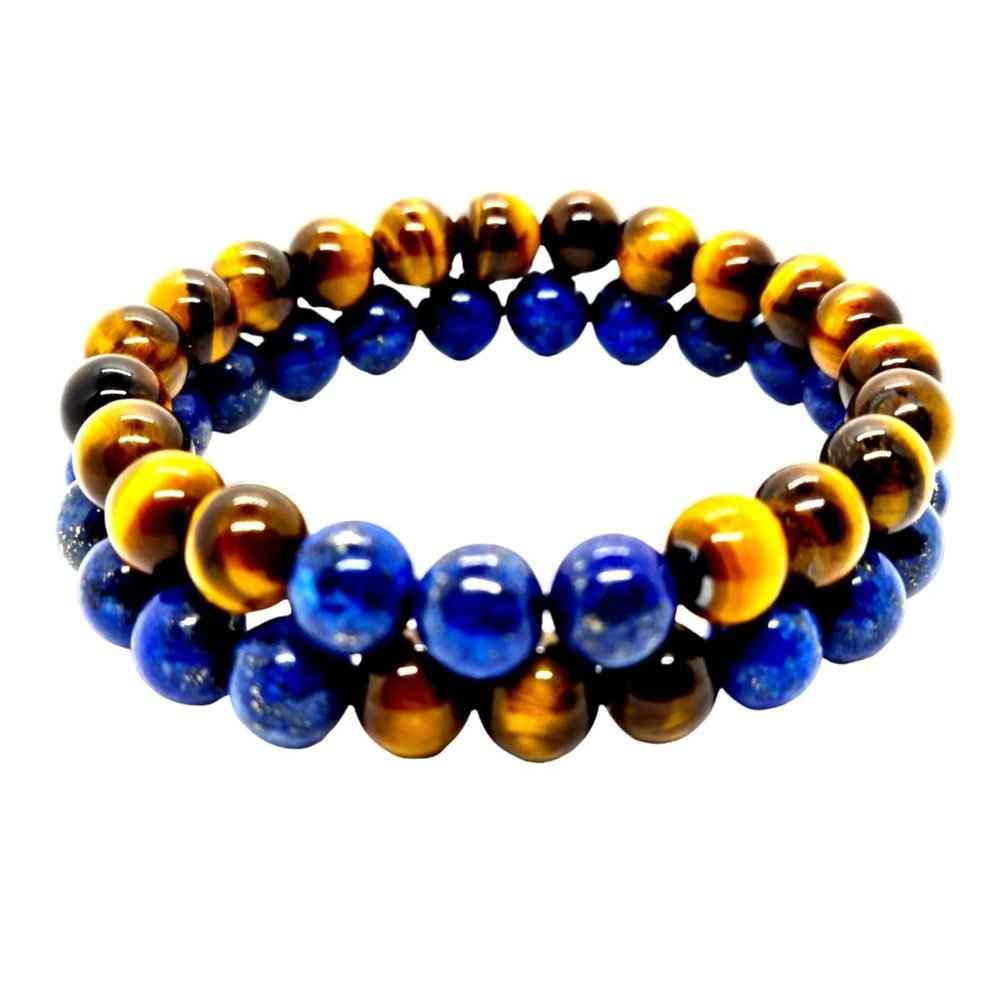
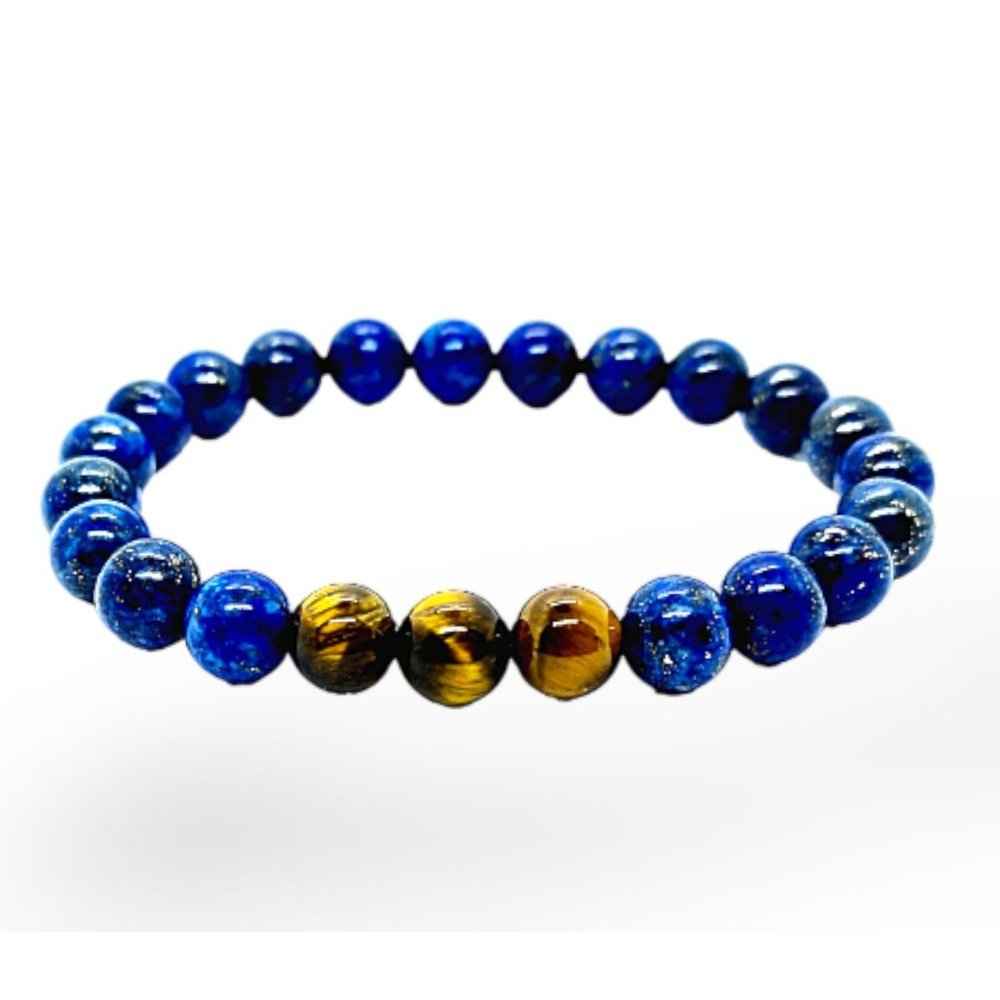
Lapis lazuli round beads (typically 6 mm to 10 mm) are widely used in stretch and knotted bracelets. The rich deep blue provides strong visual impact even in small bead sizes. In necklaces, lapis rounds and tumbled pendants are particularly effective because the flat, even polish across each bead gives a consistent colour when multiple beads are strung together. Browse our lapis lazuli jewellery.
What pairs well with lapis lazuli
Lapis lazuli's deep blue works with a specific set of stone pairings. In bracelets, hardness compatibility is important given lapis is softer than most companions:
- Pyrite (Mohs 6 to 6.5): The most natural pairing. Pyrite is already present inside lapis; using loose pyrite beads alongside lapis extends that visual relationship. Deep blue alongside metallic gold is one of the most striking colour combinations in crystal jewellery.
- Clear Quartz (Mohs 7): Colourless and clean alongside deep blue. The contrast is strong and the brightness of quartz makes the lapis blue appear even more saturated. Clear Quartz is slightly harder than lapis, so separate storage is advisable for bracelets.
- Moonstone (Mohs 6 to 6.5): Pale white with blue adularescence alongside deep blue. A historically resonant pairing: both stones have long associations with night sky imagery.
- Gold-tone settings: Sterling silver and gold-tone both work with lapis, but gold-tone is particularly effective because it echoes the pyrite flecks already present in the stone. This is the combination used in ancient Egyptian lapis jewellery.
Lapis lazuli in history
Lapis lazuli has one of the longest documented histories of any stone used in jewellery and art. Key dates:
- Around 4000 BCE: Lapis lazuli jewellery and objects found in Mesopotamian burial sites (modern Iraq). Trade routes from Afghanistan established.
- Around 3000 BCE: Extensive use in Egyptian jewellery, ornaments and inlay work. Used in the death mask of Tutankhamun (circa 1323 BCE). Ground as blue eyeshadow by Egyptian women including Cleopatra.
- 1200 BCE to 400 CE: Greek and Roman use in jewellery and as a luxury trade commodity.
- 9th to 17th century CE: Ground into ultramarine pigment for European painting. Most expensive pigment in use, reserved for the most important figures in religious compositions.
- 1826: Synthetic ultramarine invented, ending lapis lazuli's role as a pigment source. Value shifts entirely to jewellery and decorative use.
- Today: Sar-e-Sang mine still the world's primary fine lapis source, operating continuously for 6,000 years.
Popular lapis lazuli pieces
A small selection of customer favourites. Swipe to see more.